What is Nutritional Ketosis?
- Richard Phillips

- 3 hours ago
- 6 min read
Nutrition · Metabolic health
Key takeaways
--------------------
- Nutritional ketosis is a defined, measurable metabolic state: blood β-hydroxybutyrate between roughly 0.5 and 3.0 mmol/L.
- It occurs when carbohydrate intake is low enough for the liver to convert fat into ketone bodies, which fuel the brain and muscles.
- It is physiologically distinct from diabetic ketoacidosis, a medical emergency involving ketone concentrations several times higher alongside high blood glucose.
- Blood testing is the most reliable way to confirm ketosis; breath and urine methods are less dependable, especially after the first weeks.
- Some groups — including people using insulin or SGLT2 inhibitors and women who are pregnant — should seek medical guidance before restricting carbohydrate.
A Metabolic State
----------------------------------------
Nutritional ketosis describes a metabolic state rather than any particular menu. When carbohydrate intake falls low enough — typically below about 50 grams per day, though the threshold varies between people — the liver begins converting fat into molecules called ketone bodies, and their concentration in the blood rises into a range conventionally defined as 0.5 to 3.0 mmol/L.
The state is reached and left according to what has been eaten in the preceding days. A person is not “in ketosis” because of a food philosophy; they are in ketosis when their blood chemistry says so, which is why the concept belongs to measurement rather than identity.
How the body produces ketones
----------------------------------------
It was once thought that the brain cannot run on fat directly, and the body stores only a modest amount of carbohydrate. Classic physiological studies of fasting showed how this problem is solved: the liver partially oxidises fatty acids into ketone bodies — principally β-hydroxybutyrate and acetoacetate — which circulate in the blood and can supply a large share of the brain’s energy when glucose is scarce. Neurons were long thought to depend primarily on glucose metabolism for ATP production. However, recent findings from three laboratories show neurons metabolise long-chain fatty acids as alternative fuel.
This is ordinary human physiology rather than an exotic trick. The same machinery runs during an overnight fast, during prolonged exercise, and in exclusively breastfed infants. Sustained carbohydrate restriction simply holds the machinery switched on, and modern research has additionally shown that ketone bodies act as signalling molecules with effects on gene expression and inflammation that go beyond their role as fuel.
Nutritional ketosis is not diabetic ketoacidosis
-----------------------------------------------------------
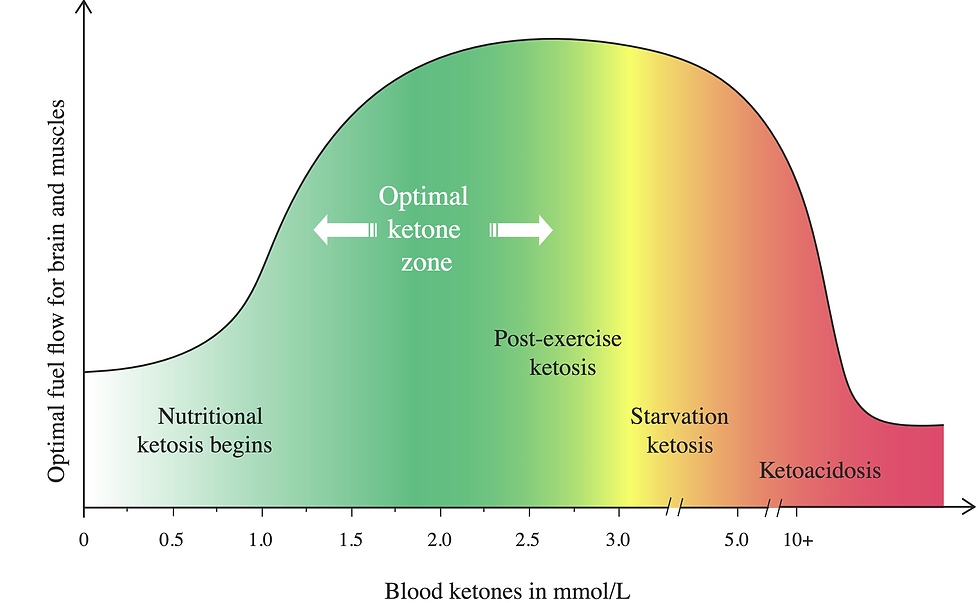
Ketone levels:
Nutritional ketosis: roughly 0.5–3.0 mmol/L. Diabetic ketoacidosis: commonly above 10 mmol/L.
Insulin:
In nutritional ketosis, insulin is present and regulating ketone production. Ketoacidosis occurs when insulin is absent or severely deficient, so production runs unchecked.
Blood glucose:
Normal or low-normal in nutritional ketosis; typically very high in diabetic ketoacidosis.
Blood pH:
Maintained within the normal range in nutritional ketosis; dangerously acidic in ketoacidosis.
Who is at risk of ketoacidosis:
Principally people with type 1 diabetes, and some people with type 2 diabetes taking SGLT2 inhibitor medication. It is a medical emergency.
> The regulated state and the emergency share a word and little else. Insulin is the difference: present and governing in one, absent in the other.
How ketosis is measured
------------------------------------
Three methods are in common use, and they are not equally dependable.
Method | What it measures | Reliability
------------------------------------------------
Blood meter | β-hydroxybutyrate in capillary blood | The reference method for practical purposes; strips carry a per-test cost
Breath analyser | Acetone in exhaled air | Correlates only loosely with blood values; useful for trends rather than numbers
Urine strips | Acetoacetate excreted in urine | Often useful in the first weeks, then progressively misleading as the body adapts and excretes less
Urine strips turning “negative” after several weeks usually reflects adaptation, not loss of ketosis — the kidneys waste fewer ketones as tissues become better at using them.
What happens in the first weeks
----------------------------------------
Entering ketosis and being adapted to it are different things. Blood ketones rise within days of carbohydrate restriction, but the broader adjustments — enzymes, electrolyte handling, the brain’s fuel mix — unfold over weeks. Research in athletes suggests aspects of fat metabolism continue shifting for months.
The early period commonly brings fatigue, headaches and irritability, largely attributable to sodium and fluid losses as insulin falls, and largely preventable with attention to salt, fluids and adequate food. These practicalities are covered in a separate article in this series.
Who should be cautious
-------------------------------
Carbohydrate restriction changes medication requirements quickly in some conditions. People using insulin or sulfonylureas can experience hypoglycaemia if doses are not adjusted, and SGLT2 inhibitors carry a specific ketoacidosis risk in combination with carbohydrate restriction. Anyone in these groups should involve the clinician who prescribes their medication before changing how they eat.
Pregnancy and breastfeeding, a history of disordered eating, and rare inborn errors of fat metabolism are further reasons to seek individual guidance rather than general information.
Summary
-------------
Nutritional ketosis is a regulated, measurable metabolic state in which the liver supplies ketone bodies as an additional fuel, defined by blood β-hydroxybutyrate of roughly 0.5–3.0 mmol/L. It is produced by ordinary physiology, is distinct from the medical emergency of ketoacidosis, and is best confirmed by blood measurement. Adaptation takes weeks rather than days, and people taking glucose-lowering medication should not enter it without clinical supervision.
FAQs
-------
Q: How long does it take to get into ketosis?
Blood ketones typically rise above 0.5 mmol/L within two to four days of restricting carbohydrate below roughly 50 grams per day, though the threshold and timing vary between individuals. Full adaptation to using ketones efficiently takes considerably longer — weeks to months.
Q: Is ketosis dangerous?
Nutritional ketosis in a metabolically healthy person is a regulated state, kept within bounds by insulin. The dangerous condition, diabetic ketoacidosis, involves far higher ketone concentrations alongside high glucose and occurs when insulin is absent — principally in type 1 diabetes. People taking insulin or SGLT2 inhibitors need medical guidance before restricting carbohydrate.
Q: Do I need to measure ketones?
Measurement is the only way to know the state has been reached, since symptoms are unreliable. A blood meter reading β-hydroxybutyrate is the dependable method; urine strips become misleading after the first weeks.
Q: What level of ketones should I aim for?
Anywhere within 0.5–3.0 mmol/L is nutritional ketosis. Higher readings within that range have not been shown to produce better outcomes for most purposes, and chasing higher numbers is not a goal the evidence supports.
References
-----------------------------------------------------------------------------------------------------------------
- Cahill, G.F. (2006) ‘Fuel metabolism in starvation’, Annual Review of Nutrition, 26, pp. 1–22. doi:10.1146/annurev.nutr.26.061505.111258
- Owen, O.E., Morgan, A.P., Kemp, H.G., Sullivan, J.M., Herrera, M.G. and Cahill, G.F. (1967) ‘Brain metabolism during fasting’, Journal of Clinical Investigation, 46(10), pp. 1589–1595
- Puchalska, P. and Crawford, P.A. (2017) ‘Multi-dimensional roles of ketone bodies in fuel metabolism, signaling, and therapeutics’, Cell Metabolism, 25(2), pp. 262–284. doi:10.1016/j.cmet.2016.12.022
- Puchalska, P. and Crawford, P.A. (2021) ‘Metabolic and signaling roles of ketone bodies in health and disease’, Annual Review of Nutrition, 41, pp. 49–77. doi:10.1146/annurev-nutr-111120-111518
- Newman, J.C. and Verdin, E. (2014) ‘β-hydroxybutyrate: much more than a metabolite’, Diabetes Research and Clinical Practice, 106(2), pp. 173–181. doi:10.1016/j.diabres.2014.08.009
- Veech, R.L., Chance, B., Kashiwaya, Y., Lardy, H.A. and Cahill, G.F. (2001) ‘Ketone bodies, potential therapeutic uses’, IUBMB Life, 51(4), pp. 241–247. doi:10.1080/152165401753311780
- Gershuni, V.M., Yan, S.L. and Medici, V. (2018) ‘Nutritional ketosis for weight management and reversal of metabolic syndrome’, Current Nutrition Reports, 7(3), pp. 97–106. doi:10.1007/s13668-018-0235-0
- Jensen, N.J., Wodschow, H.Z., Nilsson, M. and Rungby, J. (2020) ‘Effects of ketone bodies on brain metabolism and function in neurodegenerative diseases’, International Journal of Molecular Sciences, 21(22), 8767. doi:10.3390/ijms21228767
- García-Rodríguez, D. and Giménez-Cassina, A. (2021) ‘Ketone bodies in the brain beyond fuel metabolism’, Frontiers in Molecular Neuroscience, 14, 732120. doi:10.3389/fnmol.2021.732120
- Paoli, A., Bosco, G., Camporesi, E.M. and Mangar, D. (2015) ‘Ketosis, ketogenic diet and food intake control: a complex relationship’, Frontiers in Psychology, 6, 27. doi:10.3389/fpsyg.2015.00027
- Volek, J.S., Noakes, T. and Phinney, S.D. (2015) ‘Rethinking fat as a fuel for endurance exercise’, European Journal of Sport Science, 15(1), pp. 13–20. doi:10.1080/17461391.2014.959564
- Cox, P.J. et al. (2016) ‘Nutritional ketosis alters fuel preference and thereby endurance performance in athletes’, Cell Metabolism, 24(2), pp. 256–268. doi:10.1016/j.cmet.2016.07.010
- Zając, A., Poprzecki, S., Maszczyk, A., Czuba, M., Michalczyk, M. and Zydek, G. (2014) ‘The effects of a ketogenic diet on exercise metabolism and physical performance in off-road cyclists’, Nutrients, 6(7), pp. 2493–2508. doi:10.3390/nu6072493
This article describes research and is provided for general information. It is not medical advice, and decisions about diet alongside any medical condition or medication belong with a qualified clinician. APEX · apexmet.org
Comments